Meria Martell
Fire & BloodMeria Martell, the Princess of Dorne who held power for six decades, denied Aegon’s conquest the submission it demanded. Rather than meet his dragons and armies in a decisive battle, Dorne’s resistance left the invaders with no clear victory to claim. Meria’s refusal became the defining statement of her rule: Dorne would not kneel, even when its survival came at a terrible cost.
Identity and Rule
The histories describe Meria as eighty years old when Rhaenys Targaryen reached Sunspear, and say that she had ruled the Dornish for sixty years. They portray an elderly woman in poor health, blind and nearly bald, whose age had not diminished her political judgment. Argilac Durrandon had mocked her as the Yellow Toad of Dorne, a hostile nickname that later accounts preserve alongside the defiance it was meant to belittle.
Her position was distinct from that of rulers who could be compelled to submit by the capture of a castle or the defeat of a field army. Meria told Rhaenys that Dorne had no king to surrender and that she herself would neither fight nor kneel. Her answer denied the premise that the Targaryens could turn military superiority into legitimate rule simply by demanding allegiance.
The Encounter at Sunspear
Rhaenys’s flight across Dorne revealed the limits of the conquest. A Dornish force guarded the Prince’s Pass, but Rhaenys flew over it rather than engage. At Vaith she found the castle abandoned; the townspeople left there were women, children, and old men, and answered questions about their absent lords only by saying they were away. Godsgrace was deserted as well. At the Planky Town, a floating settlement of boats and barges joined by ropes, chains, and planks, only a few old women and small children appeared as Meraxes circled above.
At Sunspear, unlike the other places Rhaenys had visited, Meria was waiting. The encounter set the queen’s threat of a return with fire and blood against the princess’s declaration that Dorne would remain Unbowed, Unbent, Unbroken. Meria warned that the invaders might burn the country but would not make its people bend or bow, and told Rhaenys that she was not wanted there. The exchange ended without submission or battle. Rhaenys departed, and Dorne remained unconquered.
The episode presents resistance through absence as well as speech. Rhaenys could reach the castles and settlements, but found neither the lords she sought nor a population ready to deliver Dorne into her hands. The narrative does not say who ordered the inhabitants’ departure or explain the absent lords’ plans; it records the pattern and its effect. Meria’s force in the final meeting lay in refusing the terms on which the invaders expected victory to be measured.
War and the Limits of Victory
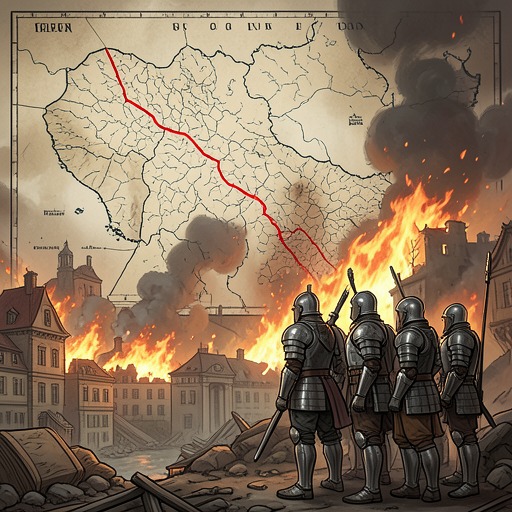
Dorne’s resistance continued through the First Dornish War, fought from 4 to 13 AC. By its final years the country had suffered famine, plague, and blight, and traders from the Free Cities described it as a blasted land. Yet House Martell still held to its defiant words. A captive Dornish knight told Queen Visenya that Meria would sooner see her people dead than enslaved to House Targaryen; Visenya answered that she and her brother would be glad to oblige the princess. The exchange shows the brutal terms on which the war was understood, though it does not establish that Meria sought her people’s deaths. Her stated position was refusal of Targaryen rule, not a promise about the cost others would pay.
The histories also record how that refusal was judged beyond Dorne. North of the Red Mountains, some lords and knights treated the tactics associated with Meria as cowardice and dishonor, turning Dornish courage into a mocking phrase. One scribe likened her to a toad retreating into its hole; another accused her of fighting through deceit and witchcraft. These judgments came from the victors’ side of the conflict, and the account contrasts them with the fact that the dragons had not secured Dorne’s submission. Meria’s achievement was therefore inseparable from a dispute over what counted as victory: her opponents scorned the means, while Dorne remained unconquered.
Death and Legacy
Age and ill health, rather than dragons or armies, ended Meria’s rule. She died in bed in 13 AC, and her son Nymor succeeded her as Prince of Dorne. Sixty years old and already in failing health, Nymor had little appetite for further slaughter. At the start of his reign he sent an embassy to King’s Landing, led by his daughter Deria, carrying the skull of Meraxes and offering terms of peace.
The proposal faced fierce opposition. Visenya and her allies insisted that peace without submission would dishonor Rhaenys’s death and might invite rebellion; Orys Baratheon argued for punishing Deria, while Aegon rejected harming an envoy who had arrived under a banner of peace. The king was close to continuing the war. Grand Maester Clegg later suggested that Nymor might have threatened to hire the Faceless Men of Braavos to kill the king’s young heir, Aenys, if his offer were refused, but the account stresses that this explanation cannot be known with certainty.
The peace proposals ended the First Dornish War, but they did not erase its bitterness. The histories describe Meria as the ruler who achieved what other opponents of Aegon had not: she kept Dorne outside his dominion. They also record the contempt her methods attracted and the desire for a future reckoning among those who had lost kin in the fighting. Aegon would rule for another twenty-four years, yet the Dornish conflict was his last war. Meria’s legacy thus rests on a hard contrast: a devastated country, a contested reputation, and a conquest that never became submission.